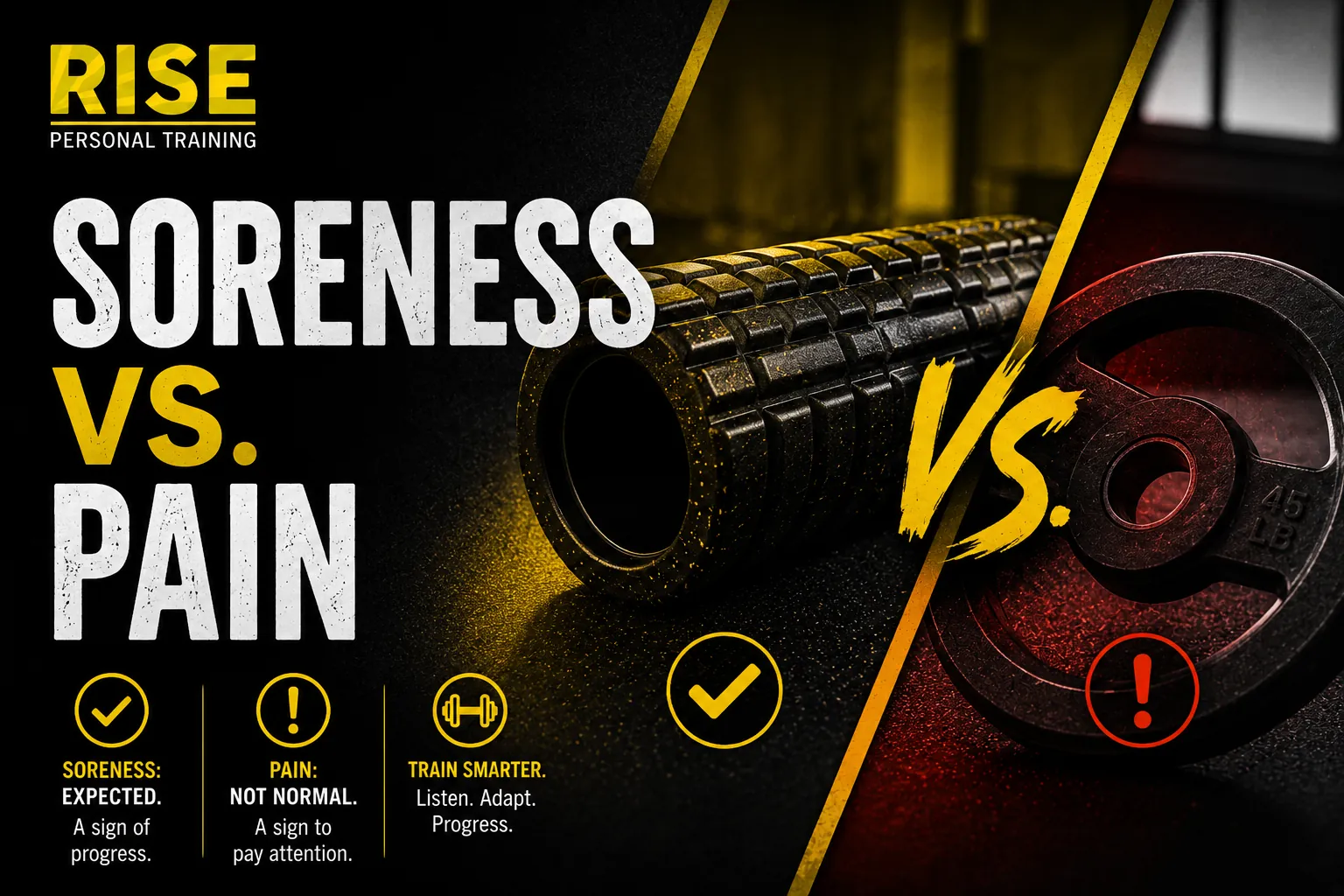
Soreness Vs Pain
Understanding the difference between soreness and pain can make a huge difference in your progress, consistency, and injury prevention. The truth is,...
Understanding the difference between soreness and pain can make a huge difference in your progress, consistency, and injury prevention. The truth is, not all discomfort means you should stop training. But not all discomfort should be pushed through either.
Here is how to tell the difference and what to do.
What muscle soreness actually is
Soreness is the tenderness or stiffness you feel in muscles after a workout, especially when you are new to training or starting a new program.
It often happens when: • You begin lifting for the first time • You increase intensity or weight • You try new exercises or rep ranges • You return after time off
Soreness is normal. It is part of your body adapting to stress and getting stronger.
Many beginners think soreness means they should skip workouts. On the other hand, experienced lifters sometimes think they need to feel sore to have had a good workout. Neither is true.
As your body adapts, you may feel less sore over time. That does not mean the workout is ineffective. It means your muscles are becoming more efficient.
You can still train while sore
In most cases, you should still come to the gym even if you are sore.
Movement actually helps reduce soreness because it increases blood flow to the muscles. A proper warm up, foam rolling, and mobility work can make you feel significantly better once you start moving.
A good program also adjusts based on how you feel. If you are extremely sore, we can modify intensity, change exercises, or focus on different muscle groups while still keeping you progressing.
When soreness becomes too much
There is a difference between normal soreness and overdoing it.
If soreness is so severe that you cannot move normally, walk comfortably, or perform daily tasks, training intensity likely needs to be adjusted. Training hard does not always mean training smart.
Consistency matters more than destroying yourself in one workout.
Understanding pain is different
Pain is not the same as soreness.
Pain is typically: • Sharp or stabbing • Located in a joint rather than the muscle • Triggered by specific movements • Persistent during daily activities
Common areas include shoulders, knees, elbows, wrists, and hips.
If something hurts during an exercise, that is a clear signal to stop or modify. We never want to push through pain.
You can still train with pain by adjusting
Having pain in one area does not mean you need to stop exercising entirely.
We can adjust around the injury by: • Training other muscle groups • Strengthening surrounding muscles • Modifying range of motion or load • Avoiding movements that trigger pain
For example, we have had members train successfully with ankle injuries, wrist issues, and knee pain by simply modifying the program while healing.
Staying active often helps recovery more than complete inactivity.
When to seek medical help
If pain becomes chronic, worsens, or affects your daily life outside the gym, it is time to get evaluated by a medical professional.
Training can continue around many injuries, but understanding the root cause is important for long term health.
The bottom line
Soreness is normal and usually safe to train through. Pain is a warning sign and should be adjusted around.
The goal is balance. Train consistently, train smart, and communicate with your coach about how your body feels.
Do not let soreness or minor injuries become barriers that stop your progress. With the right adjustments, you can almost always keep moving forward.
Listen to the full episode “Soreness and Pain” on the Rise Personal Training Podcast
Apple Podcast
Have Questions???
Ryan Sellz
Founder of Rise Personal Training
View Author Profile →