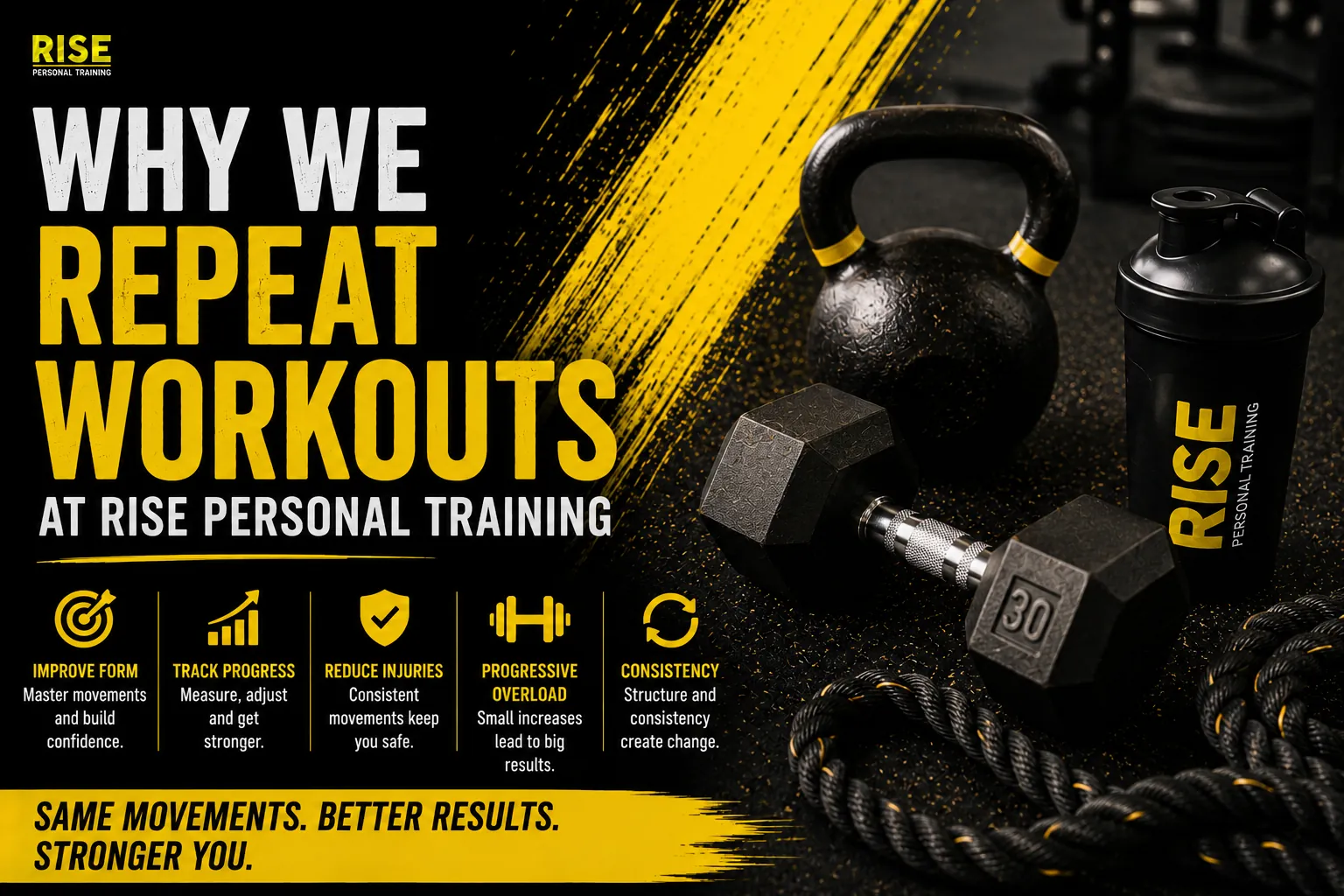
Why We Repeat Workouts at Rise Personal Training
Learn why repeating workouts and using progressive overload is key to building strength, improving form, and achieving long-term results safely.
If you've been training with us for a while, you've probably noticed we repeat workouts and stick to certain rep ranges for a few weeks at a time.
And yes… we know everyone notices when the 12 rep phase comes back.
But there's a reason behind it.
At Rise, our programming is built around helping you get stronger, move better, avoid injuries, and make long term progress. Don't just leave sweaty after random workouts.
Why Repeating Workouts Matters
A lot of people think workouts always need to be completely different to be effective.
In reality, repeating movements is one of the best ways to:
• Improve form • Build strength safely • Track progress • Reduce injury risk • Create progressive overload
If workouts changed every single day, your body would spend more time learning movements than actually improving them.
What Is Progressive Overload?
Progressive overload simply means gradually improving over time.
That could mean:
• Lifting heavier weight • Improving form • Controlling movement better • Completing more reps • Feeling stronger week to week
Repeating workouts allows us to measure progress instead of guessing.
For example:
Week 1 → You learn the movement Week 2 → You feel more comfortable and confident Week 3 → You push harder and get stronger
That progression is where results happen.
Why We Use Different Rep Ranges
At Rise, we rotate through different phases and rep ranges because different goals require different training styles.
Lower reps (like 6 reps): • Focus more on strength • Allow heavier weights • Build power and stability
Higher reps (like 12 reps): • Increase muscular endurance • Build muscle • Improve conditioning
Each phase challenges your body differently while still keeping you progressing safely.
Repeating Workouts Helps Prevent Injuries
One of the biggest mistakes people make is constantly doing random workouts with no structure.
When movements constantly change: • Form usually suffers • Progress is harder to track • People push too heavy too quickly • Injury risk goes up
Repeating exercises gives your body time to adapt properly.
It also allows coaches to: • Correct your form • Modify movements if needed • Monitor pain or limitations • Help you progress safely
Progress Comes From Consistency
You do not need a completely different workout every day to get results.
You need: • Structure • Consistency • Progressive overload • Good coaching • Time
The workouts may repeat, but your body is improving every week.
And when you look back months later and realize you went from squatting 20 pounds to 100+ pounds safely and confidently… that's where the real progress shows up.
Final Takeaway
Repeating workouts is not "boring." It's intentional.
The goal isn't random exhaustion.
The goal is long term progress, better movement, more strength, and fewer injuries.
Trust the process. Keep showing up. The progress adds up.
Ryan Sellz
Founder of Rise Personal Training
View Author Profile →